Poland
 Global
 United Kingdom
 USA
USA France
Case Study: ONLICOM S.R.L.
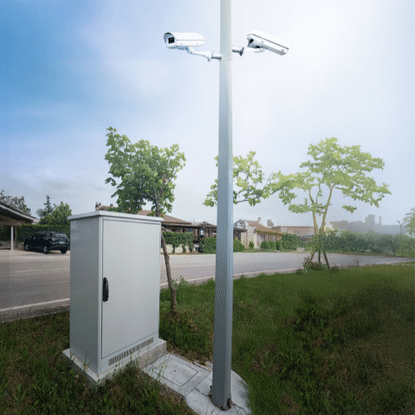
URBAN VIDEO SURVEILLANCEIn this case study, ETA brand products were chosen for the implementation of video surveillance centres in the municipality of Campobasso, Molise, for buildings at risk.
The project exploited the benefits and pluses of ETA's outdoor line, which proved to be particularly suitable for application in urban video surveillance and security.
ONLICOM S.R.L.: a company specialising in the creation of complex, self-managed structures, without any human intervention, with the aim of making the use of available technologies and their integration easier and more efficient.
Consisting of a team of qualified and certified system integrators, ONLICOM follows a very precise process in the realisation of the various projects: from the feasibility study and analysis, to the executive stage and start of work, up to testing. After this stage, the work is always followed up through ordinary, extraordinary and evolutionary maintenance.
The main services offered by ONLICOM include:
- Advanced video surveillance systems, with analysis systems;
- Wireless hotspot systems - radio bridges, which allow a network to be implemented via radio technology, exploiting wireless standards;
- Network cabling and fibre solutions, the fundamental unit and hub of the company's information system, essential for receiving and transmitting data.
For the realisation of the video surveillance centre and the need for application in an outdoor environment, an outdoor cabinet was required, which would ensure the perfect protection of the switchboard's internal components from environmental factors of varying nature and intensity, extreme temperatures and solar radiation, vandalism and atmospheric agents.
Given the customer's needs and the required application, the choice fell on a cabinet from the E VIS range, made of sheet steel and single-walled.
The model in question is characterised by a one-piece structure, with an anti-vandal profile and no possibility of access to the cabinet with the door closed; a guarantee for the safety of the installation and the protection of the internal components.
The E VIS cabinet not only embodies the maximum flexibility typical of ETA solutions, but also offers a high degree of convenience and functionality. The installation of the hinged roof required only three screws, while the large cable entry made the wiring process significantly faster and more efficient.
The presence of ventilated front beams and ventilation openings on the roof promote proper air circulation, preventing excessive overheating of the internal equipment.
The IP56 safety rating, together with the two-component polyurethane foam gasket, also guarantees high protection of the equipment against dust and splash water. This factor, combined with the IK10 impact resistance rating, has enabled ONLICOM to use E VIS with excellent protection and safety.
The choice of E.T.A. as a partner for outdoor solutions was strategic and well-considered. In this regard, ONLICOM's Technical Office Manager, Engineer Mariano Marzocca, says: 'A cabinet, in itself, is just a metal component; the real difference is the quality of the product and, above all, the reliability of the company that makes it.' Testimony to this is also the fact that ONLICOM had already experimented with ETA indoor carpentry for other applications.
Compact packaging, flat-pack convenience, quick and easy assembly, product versatility, durability and a very high level of painting success are other strengths that ONLICOM recognised in E.T.A. products.
The vastness and completeness of the E.T.A. catalogue enabled ONLICOM to successfully realise the urban video surveillance project.
Although in the past ONLICOM had used customised switchboards from other suppliers, in this specific case it chose to rely exclusively on E.T.A. The decision was dictated by the negative experience with other solutions, which had a less resistant paint finish, were easier to corrode and required frequent maintenance. The cataphoresis process used during the painting phase proved to be a fundamental added value, guaranteeing superior resistance and reduced maintenance requirements.